
Every CBCT scan you take captures far more than the area of interest. A small FOV scan often still images the maxillary sinus, adjacent bone, nearby teeth, and surrounding soft tissue. More than just the success of the planned treatment, these structures have their own set of considerations that may affect other areas of the patient's life. Consider a recent case reviewed by one of our oral and maxillofacial radiologists (OMRs): they found a hyperdensity in the brain's soft tissue that was confirmed through medical follow-up to be a meningioma.
While CBCT captures so much information and has advanced diagnoses, it can be overwhelming to understand what's in the scan, especially when the medicolegal standpoint is clear that the entire scan volume is your responsibility, not just the region you were evaluating. Does that mean you need to become an OMR? Or that you should always refer your scans for OMR review? Not at all. The answer is somewhere in between, and it should be consistent, repeatable, and defensible.
A framework built around your existing workflow
The Traffic Light Protocol is a referral decision framework developed to bring consistency to exactly that question. It organizes CBCT cases into three categories based on complexity, anatomical scope, and clinical risk, so that the decision of whether to self-interpret or refer to an OMR follows a repeatable standard rather than a case-by-case gut feeling. It is based on our real-world collective radiology experience and nearly one million CBCT scans interpreted.
Green light cases are lower-complexity scans where a well-trained clinician with good systematic review habits can self-interpret with confidence. Think straightforward single-tooth endodontics or a low-risk single implant site with unremarkable anatomy.
Yellow light cases are where your clinical judgment comes into play. Routine implant planning with medium FOV, TMJ evaluation, airway assessment, and endodontic retreatment are some examples that we find require heightened awareness. Some practitioners are well-equipped to handle some of these areas. Others benefit from a specialist's perspective, especially when there are anatomical variations. The protocol doesn't make that call for you, but it gives you clear criteria to make it deliberately.
Red light cases should always go to an OMR in our experience, as they carry the highest liability and diagnostic uncertainty for most practitioners. Large FOV scans, suspected pathology, unclear etiology, maxillofacial trauma, and high-risk planning naturally fall here, as do patients with complex medical history and legal concerns. The case presented earlier is an example of how all of the data contained in a large FOV scan met this "red light" criteria.
What the eBook covers
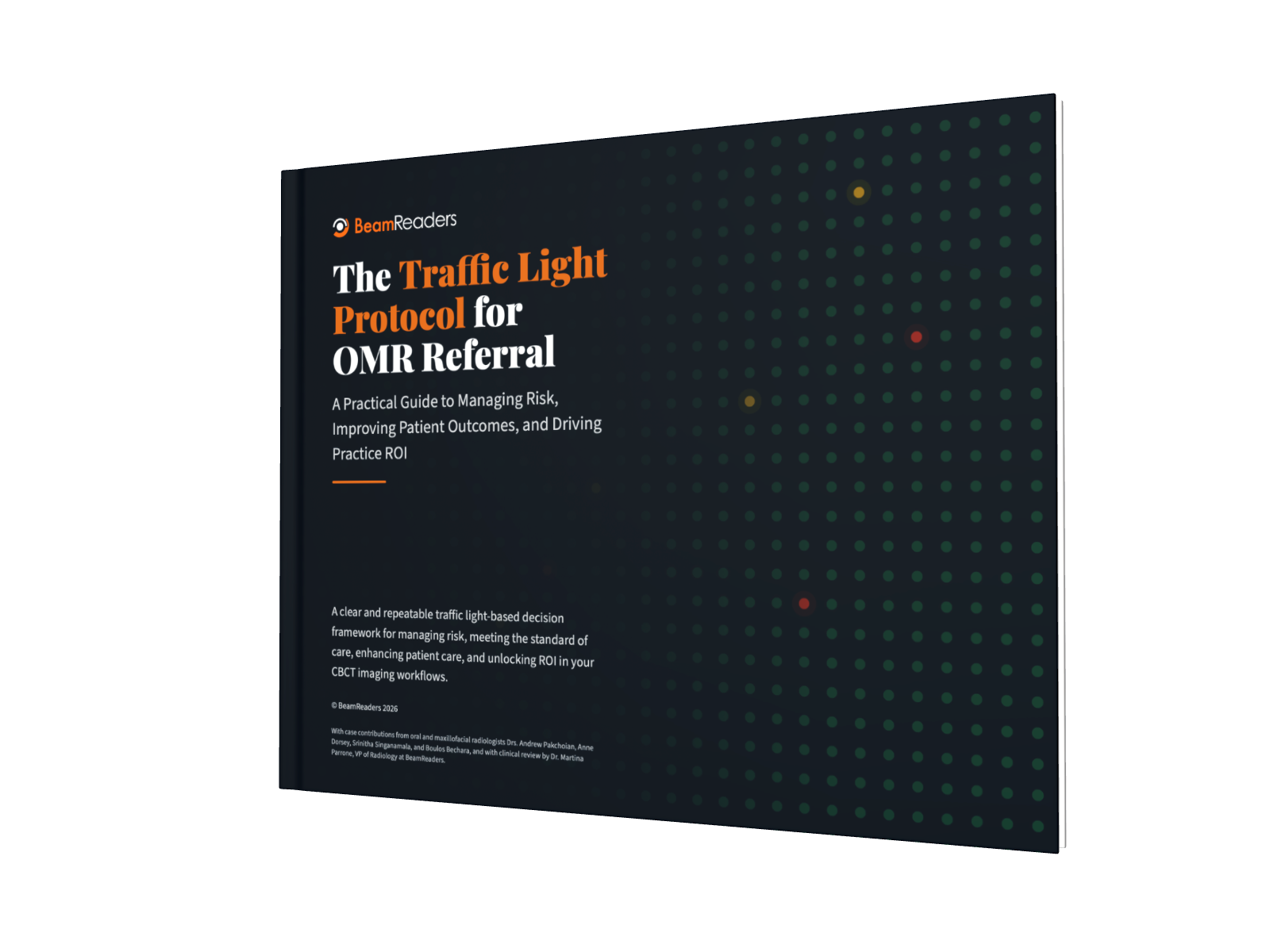
The Traffic Light Protocol for OMR Referral walks through the full framework in detail, including the clinical and medicolegal context behind it and specific case-type guidance for each tier, along with real cases from our team of oral and maxillofacial radiologists to help illustrate these scenarios.
It also includes a documentation worksheet to guide you in performing thorough and defensible systematic reviews, as well as communication templates you can use with patients to explain how referrals work and how incidental findings are communicated.
If your practice uses CBCT and you don't currently have a written standard for when to refer, this is a practical place to start.